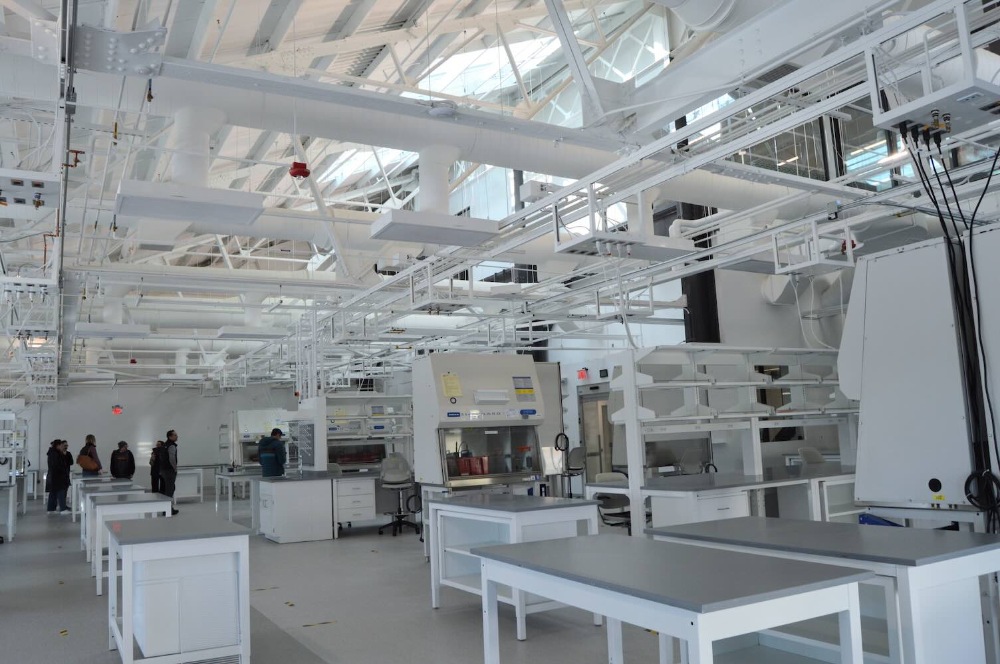
 Earlier this year, the ALS Therapy Development Institute (ALS TDI) announced a major expansion of our team and facilities, including a new 33,000-square-foot laboratory in Watertown, MA. According to ALS TDI’s CEO and Chief Scientific Officer, Dr. Fernando Vieira, increasing the organization’s capability and capacity is a necessary step to meet this unique moment in ALS research.
Dr. Vieira joined us to elaborate on the opportunities presented by the current state of ALS research, and how this expansion will help us take advantage of them.
ALS TDI: You’ve said that ALS research has reached a turning point. What makes you believe that?
Dr. Fernando Vieira: ALS research has been burgeoning. We're at a moment of an explosion of ideas that have come out of the understanding that ALS is not really one single disease—it's likely multiple diseases. This is compelling the research community to find lots of different ways to approach ALS drug discovery. It’s an exciting moment, but it comes with an obligation to find the best ways to address the needs of everybody living with ALS as we move these ideas forward.
There are so many new technologies that have been developed in the last few years. Part of our responsibility is to bring these new approaches into the research that we're doing today so that we can take full advantage of them for our community.
Another consideration is that we simply need to do more, faster. We need to build the capacity to conduct the research that we already do – but more efficiently and more rapidly. That means bringing in more skilled scientists and providing them with more equipment, sometimes upgraded equipment, that allows us to get the job done faster.
How do you feel about ALS TDI’s ability to meet this moment?
I can say that ALS TDI is well poised to meet the moment because of the expertise that we’ve built in-house over multiple decades. We’re unique in the sense that we can address a therapeutic concept from the beginning all the way to the cusp of clinical development.
We have our Cell Biology team, who study the disease at a mechanistic level and screen drugs in cells from people with ALS. Our In Vivo Pharmacology team can conduct top-notch experiments in animal models of ALS and develop therapeutic ideas into candidates that really have promise as a medicine for people. Then, we can tie all of that together into the context of a data driven understanding the disease by mining data directly from people with ALS through our ARC Study.
it’s a strong position and we need to take advantage of that.
How do you believe this expansion will help us take advantage of that position?
The expansion will allow us to test lots of ideas at the same time. That’s critical because ALS is not one single disease. If we want to develop treatments that can help everyone, and we want to do that quickly, we need to be pursuing many therapeutic ideas simultaneously.
So, we will have parallel tracks—where we're discovering and optimizing treatments that might be tailored to multiple specific genetic subsets at the same time as other therapeutics that are tailored toward subsets of sporadic ALS. That’s so important because we’ve seen breakthroughs in a treatment for SOD1 ALS and research advancements for C9orf72-related ALS, but there are other subtypes of ALS. There are other genetic forms, and there’s the 85% of cases that are sporadic, which may have their own genetic underpinnings once we understand more. We need to address all of those types of ALS too.
Growing our cell biology and in vivo pharmacology teams will allow us to build that capacity. We also have an opportunity through this expansion to accommodate more people into the ARC and the Champion Insights studies, where we're trying to learn about ALS directly from people with ALS and focus on specific subgroups. We collect many samples from people with ALS through these studies, and this allows us to build that biobank for our internal purposes for biomarker and target discovery. It also means that we can share those samples as resources for the rest of the ALS research community to accelerate discovery globally.
What does this expansion mean for ALS TDI’s ability to take on new projects?
Today, we’re running a lot of internal programs and a lot of collaborative programs. This expansion will allow us to accelerate some existing programs. So, for example, we are building a program around the deployment of mRNA as a therapeutic platform for ALS, with lots of different therapeutics that might be born out of that. We'll be able to accelerate that program through this expansion, while also continuing to march forward with our small molecule drug internal programs and collaborations.
Additionally, a lot of outside groups have come to us in the past few years hoping to advance their therapeutic ideas through our systems – through our cell screens and through our animal models. For example, maybe an academic lab or a small company has isolated a specific therapeutic target, like a protein that they're trying to inhibit. But they don't know how to go about finding the best potential drug to do it. That's something we can help them do. However, our bandwidth has been maxed out, and that has limited our ability to take on these collaborative efforts. So, this expansion also directly accelerates our ability to work with others to test those ideas and bring them forward as quickly as possible.
Can you talk about how the support of the ALS community has made all of this possible?
Community support has been essential to getting us to this point and will be essential going forward in a couple of different ways. Number one, it gives us flexibility in how we deploy resources. Our ability to build expertise and to continue piling knowledge on top of knowledge to get better and better ALS research and drug discovery has been critical. It's the solid foundation upon which we can build and expand. Beyond that, though, the support from the community inspires and informs us. It's what keeps our team together. We know that we're here for the people with ALS who are coming into our lab and meeting us, and it's so much more than a job. They also remind us about what matters to them. The kind of medicines that they want to see. It's so much more than science. It is a mission.
The support of Augie’s Quest to Cure ALS and so many others in our community has brought this expansion within reach. I'm grateful to the community for the support that has made it possible to build the team, to build expertise, to build infrastructure that is foundational to what we're going to be doing next—this expansion that allows us to do more, better, and faster. We’ll use it – together with our community – to end ALS.
What to Do Next: