The International Symposium on ALS/MND is the largest gathering of researchers studying amyotrophic lateral sclerosis (ALS), otherwise known as motor neuron disease (MND), in the world. The conference welcomes scientists, academics, people with ALS, and drug development researchers from around the world to share and discuss the latest research in ALS. The 2025 symposium took place in San Diego, CA, on December 5-7.
Last year, seven researchers from the ALS Therapy Development Institute (ALS TDI) joined the event, and three of our researchers took part in the symposium’s prestigious poster session, sharing their latest research with colleagues from around the world. The posters shared by our team included:
- Dr. Danielle Boyce, Principal Investigator, Real World Evidence, presented on the use of Electronic Health Record data as part of the ALS Research Collaborative (ARC) Study.
- Swetha Gurutmurthy, Associate Scientist II, presented on her work with induced pluripotent stem cell (iPSC) models of ALS.
- Kaly Mueller, Senior Associate Scientist, presented on her work testing potential Type I PRMT-inhibitor treatments in mouse models of ALS.
For more in-depth descriptions of these posters, as well as some of our scientists’ favorite presentations from other researchers at the Summit, read one:
Dr. Danielle Boyce
Research-Ready Electronic Health Records: A Reproducible Pipeline for the ARC Natural History Study
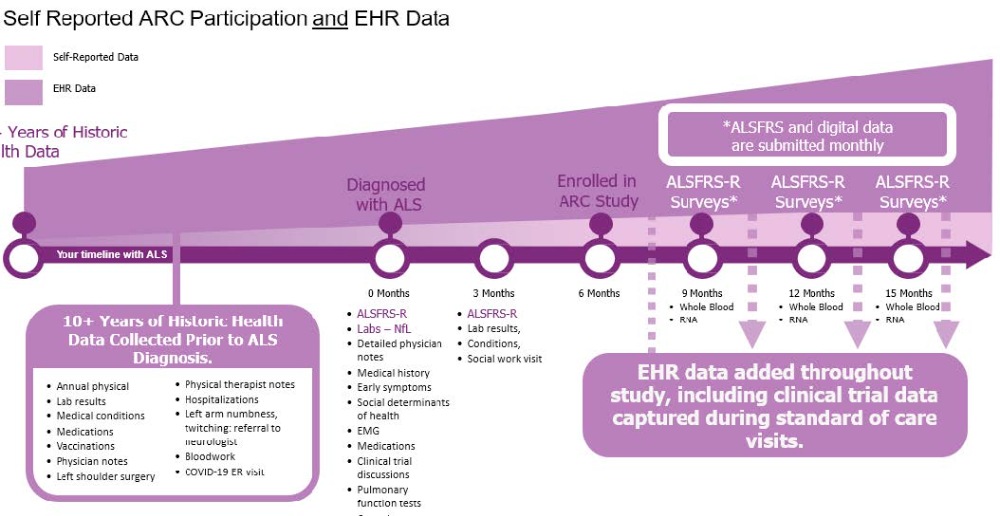
Dr. Boyce's Poster Summary: 2025 was a truly eventful year for our ARC Natural History Study electronic health records (EHR) data program. Enrollment has steadily increased, and in fact, between the time I submitted my abstract and the moment I presented it at the ALS/MND Symposium, we welcomed a significant number of new participants into the study. That kind of momentum is both exciting and motivating, as it underscores just how timely this work has become.
At the symposium, my poster focused on how we abstract and curate EHR data from ARC participants. What makes our approach unique is that participants are not required to enroll at a specific clinic or health system. Instead, they can direct their own electronic health record data from their hospital or provider straight into our database. This removes a major burden from healthcare providers and gives participants a great deal of control over their data.
Tackling Scale and Privacy
Once the data arrive, the real work begins. Each participant’s EHR can contain thousands upon thousands of files, all of which need to be reviewed, interpreted, and curated into something meaningful for research. At the same time, privacy is paramount. EHR data are full of potential identifiers and other sensitive information, so we made a deliberate decision to avoid sending participant data into the cloud or third-party tools wherever possible. To address this, I built a very simple local application that runs entirely on a local computer, such as a work laptop.
While this homegrown software isn’t flashy or highly sophisticated, it solves a problem many of us face: how to safely explore and curate raw EHR data without introducing unnecessary privacy risks. To my delight and surprise, this simplicity really resonated with people visiting the poster, representing all stakeholder groups, including academic researchers, industry leaders, and informaticians. Sometimes the most impactful solutions are the most practical ones!
Beyond the tooling itself, attendees were excited about the sheer existence of a large ALS EHR dataset. Electronic health record data in ALS are incredibly valuable and relatively rare. Many researchers in this space actively seek out raw datasets like ours that they can use to test and refine curation, extraction, and phenotyping pipelines. Thanks to global standardization efforts—including shared vocabularies, common keywords, and interoperable formats—even data coming from different hospitals and EHR vendors can support meaningful collaboration across institutions and countries.
A Conversation That Sparked Collaboration
One particularly exciting interaction came from Yusuf Abdulle, a PhD student enrolled in the EPSRC Centre for Doctoral Training in Data-Driven Health (DRIVE-Health), based at King’s College London. Yusuf’s research is co-funded by LifeArc and carried out under the supervision of Professor Richard Dobson, Professor Alfredo Iacoangeli, Professor Honghan Wu, Dr. Chris Tomlinson, and Dr. Zhi Yao. I was especially excited by Yusuf’s talk, which tackled a question we’re often asked: can we identify ALS earlier using signals already present in EHR data?
Yusuf and Jinge Wu, his joint-first co-author, used health records from nearly the entire population of England (around 67 million individuals) to evaluate whether artificial intelligence could outperform existing guideline-based checklists in identifying and predicting motor neuron disease. The results were striking: AI-based models were substantially better at predicting and diagnosing MND than current “red-flag” terms or guideline-driven approaches.
While documenting symptoms and comorbidities after diagnosis remains critical for phenotyping disease progression and understanding ALS subtypes, this work shows that AI has enormous potential to support earlier diagnoses. Yusuf and I immediately hit it off, and we’re now planning to share resources to explore how our approaches can complement one another and expand the reach of both projects. It’s exactly the kind of synergy that makes this community so special.
The ALS/MND Symposium continues to be an incredible forum for sparking new ideas and collaborations that wouldn’t happen anywhere else.
Yusuf’s conclusion reinforces the importance of this interdisciplinary gathering: “This study supports integrating AI tools with clinical expertise to enhance early detection and guide care strategies for vulnerable populations.” From practical data tools to population-scale AI models, the field is moving quickly, and it’s energizing to be part of that momentum.
For those interested, Yusuf’s talk was: C88: Characteristics and early diagnosis of motor neuron disease (MND) in 67 million individuals in England: a comparative study on phenotyping models derived by AI, knowledge graphs, and the MND Association Red Flag list, presented at the 36th International Symposium on ALS/MND.
Looking ahead, I’m excited to see how shared datasets, privacy-preserving tools, and cross-disciplinary collaboration will continue to accelerate ALS research and ultimately improve outcomes for people living with the disease.
Swetha Gurumurthy
A Robust Workflow for Cryopreservation of iPSC-Derived Motor Neurons and Optimized Expansion of Motor Neuron Progenitors for Disease Modeling.

Swetha's Poster Summary: Our optimized iPSC-to-motor-neuron workflow improves reliability and scalability by refining key culture parameters, enabling robust MNP expansion and high-quality cryopreserved motor neurons ready for consistent downstream assays.
Here, we present an optimized workflow for differentiating induced pluripotent stem cells (iPSCs) into motor neurons, with an emphasis on improving reliability, scalability, and downstream assay readiness. The work focused on identifying and optimizing the culture parameters that influence motor neuron progenitor (MNP) yield and quality, and on refining media composition to support robust MNP expansion and efficient cryopreservation.
Using an optimized differentiation workflow adapted from the Du et al. (2015) protocol1, we show that our cryopreserved motor neurons demonstrated high post‑thaw viability and expressed strong neuronal marker profiles, including ISL-1, HB9, ChAT, and VAChT. Importantly, the ability to reliably cryopreserve and recover MNs with high viability enables the creation of a flexible, ready‑to‑use cell bank that supports reproducible experiments, streamlined assay setup across long‑term studies, and efficient drug and compound screening, as researchers can access consistent batches of MNs on demand.
Furthermore, cryopreserved motor neurons exhibited expected sensitivity to exogenous GR(15) treatment, with the C9orf72 HRE line showing increased susceptibility compared to the C9orf72 control line.
Overall, our optimized workflow streamlines a meticulous differentiation pipeline to generate scalable, high-quality motor neuron progenitors (MNPs) and motor neurons suitable for disease modeling and drug discovery.
- Du, ZW., Chen, H., Liu, H. et al. Generation and expansion of highly pure motor neuron progenitors from human pluripotent stem cells. Nat Commun 6, 6626 (2015). https://doi.org/10.1038/ncomms7626
Swetha's Symposium Highlight: My favorite presentation at the 2025 Motor Neuron Disease Symposium was Dr. Don Cleveland’s talk on how proteasome inhibitors drive TDP‑43 mislocalization from the nucleus to the cytoplasm, directly linking impaired protein clearance to a central ALS/FTD pathology. Dr. Cleveland showed that proteasome inhibition in neurons can recapitulate key disease‑like TDP‑43 pathology—including reduced nuclear TDP‑43, cytoplasmic accumulation, and hallmark modifications such as phosphorylation, ubiquitination, and aggregation making it a practical approach for modeling TDP‑43 pathology in vitro.
The most compelling point was the mechanism behind TDP-43 mislocalization: reduced proteasome activity acts as an early upstream trigger that disrupts TDP-43 homeostasis and pushes it out of the nucleus.
Kaly Mueller
Targeting Type I PRMTs in ALS: In Vivo Evaluation of MS023 and GSK3368715 in TDP43Q331K and SOD1G93A Mice
Kaly's Poster Summary:
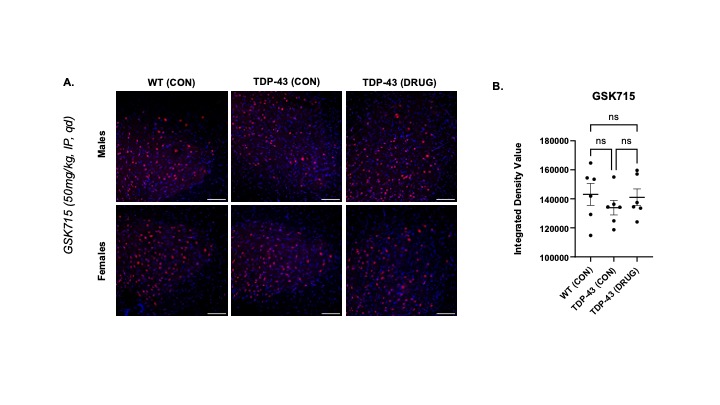
Previously, we showed that exogenous application of arginine-rich dipeptide repeat proteins, produced in C9orf72-linked ALS, induced toxicity in primary neurons and NSC-34 cells, which was significantly reduced by Type I PRMT inhibition. This poster sought to build on these findings by evaluating whether Type I PRMT inhibition, with MS023 and GSK3368715, offers therapeutic benefit in vivo. The TDP43Q331K and SOD1G93A mouse models were selected based on their replication of key features of ALS, including elevated neurofilament (NFL) levels and neuromuscular deficits. Our objectives were to examine the relationship between ADMA levels and disease progression in these models and determine whether Type I PRMT inhibition reduces ADMA levels and improves disease outcomes. In TDP43Q331K mice, GSK715 - but not MS023 - lowered plasma ADMA levels. However, neither compound reduced ADMA within the spinal cord, and neither slowed disease progression in the TDP43Q331K or SOD1G93A models at the doses tested.
Why We Share Our Research
Sharing research at the ALS/MND Symposium is a critical part of how ALS TDI accelerates progress for people living with ALS. Presenting posters allows our scientists to share new data early, answer questions from other researchers, and compare findings across different approaches to ALS research. This open exchange strengthens the science, helps avoid duplication of effort, and speeds learning across the field—ensuring that promising ideas are tested, refined, and advanced with greater confidence.
What to do Next: