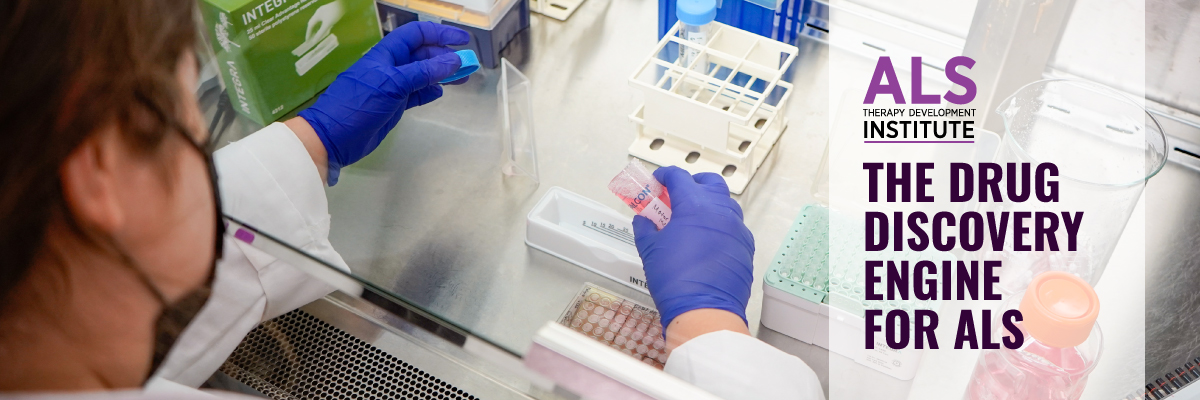
In 2025, we made meaningful strides toward our mission to develop effective treatments for everyone with ALS.
From advancing new drug candidates to launching bold collaborations that connect people, data, and technology, our work continues to push the field forward. Your ongoing support is what makes these milestones possible.
Advancing Treatments in the Lab
Our scientists are relentlessly focused on translating discoveries into therapies that can move toward human clinical trials. This year, we advanced multiple drug programs and partnerships designed to target key biological processes underlying ALS.
mRNA Technology
In collaboration with Dr. Michael Mitchell at the University of Pennsylvania, we began developing lipid nanoparticles capable of delivering mRNA-based drugs to the brain and spinal cord.
Internally, our team has already synthesized several mRNAs for testing — bringing us closer to a new class of targeted therapies.
TDI-1831
ALS TDI has been investigating copper complexes as potential treatments for ALS. From this cutting-edge program, TDI-1831 emerged as the lead candidate.
TDI-1831 is now progressing into IND-enabling studies, alongside early patient-stratification strategies that may help match therapies to specific forms of ALS.
PRMT Inhibitors
In 2020, ALS TDI researchers discovered that type 1 PRMT inhibitors can alter ALS-linked proteins associated with the C9orf72 mutation. Although this target was discovered for C9orf72-related ALS, ALS TDI scientists believe that these findings may also be relevant to other forms of ALS.
These compounds are now being tested in animal models at ALS TDI. The goal is to evaluate their ability to correct RNA mis-splicing and reduce liquid–liquid phase separation, a contributor to protein aggregation.
Profilin1 Mouse Model
Our researchers validated a new profilin1 mouse model of ALS, strengthening our ability to test treatments across additional ALS subtypes.
This work, published in Neurobiology of Disease, marks an important milestone in rigorous therapy evaluation.
Every discovery in our lab brings us closer to effective treatments for people with ALS.
Accelerating Biomarker Discovery
To evaluate potential treatments effectively, researchers need reliable, sensitive measures of ALS progression. This year, our team advanced several promising biomarker efforts.
-
We worked on correlating voice recordings and movement data with clinical outcomes – an important step in bringing these digital biomarkers closer to use in ALS trials.
-
We expanded omics data analysis to identify biological signatures that could serve as biomarkers for ALS progression or treatment response.
-
We developed new antibodies against methylated C9orf72 dipeptide repeats, offering tools for future biomarker development and possible therapeutic use in ALS.
These innovations help make ALS research more precise, more predictive, and more translatable to the clinic.
Transforming Research Through Data
Understanding ALS requires learning directly from the people who live with it. Through large-scale data collection and collaboration, we’re uncovering insights that are reshaping ALS research worldwide.
ALS Research Collaborative (ARC) Study
Now approaching 2,000 participants worldwide, the ARC Study remains the longest-running natural history study in ALS. ARC data informs research at ALS TDI and globally through the ARC Data Commons, accessed by more than 110 researchers.
ARC data is currently being utilized in 50 ongoing studies, has contributed to 6 published research papers, and has directly led to the development of five prototype digital biomarkers for ALS.
Champion Insights
Champion Insights was launched by Answer ALS and Augie’s Quest, with research led by ALS TDI. This new initiative focuses on studying groups identified as having a higher risk of developing ALS, including:
These groups may help reveal genetic, metabolic, and lifestyle factors that influence ALS development and progression.
Thank you to all of our study participants! When people share data, the entire ALS community moves closer to answers.
Powering Progress Through Collaboration
ALS TDI’s impact is strengthened through collaboration across borders, institutions, and disciplines. By sharing data, expertise, and tools, we accelerate progress for the entire ALS field.
Axol Bioscience
ALS TDI is partnering with Axol Bioscience to expand access to high-quality, patient-derived stem cell models. Using samples from ARC participants, these models will help researchers test treatments and understand ALS across different subtypes.
Corsalex
In partnership with Corsalex, ALS TDI identified several promising drug candidates for C9orf72-spectrum disorders. Building on these results, we are now advancing multiple programs through lead optimization to accelerate potential treatments for people with ALS.
C-Path
ALS TDI is working with the Critical Path Institute (C-Path) to evaluate ARC Study voice and accelerometer data as potential clinical trial outcome measures – advancing tools that make ALS trials more sensitive, patient-centered, and better able to detect meaningful change.
AMP ALS
As a Design Phase and Execution Phase partner, ALS TDI contributes ARC data, scientific expertise, and real-world insights to this NIH-led effort to improve ALS diagnosis, understanding, and treatment.
Longitude Prize on ALS
As a Longitude Prize on ALS data-sharing partner, ALS TDI is contributing more than a decade of ARC Study data to help global researchers use artificial intelligence to accelerate ALS drug discovery.
Collaboration breaks down silos, strengthens the field, and accelerates progress toward treatments and cures.
Looking Ahead
To the people with ALS who share their data, and to the entire community that supports us, thank you for making this progress possible.
Together, we are the engine driving discoveries forward.
To support our ongoing research to end ALS, donate today at als.net/donate.