ALS is a uniquely challenging disease, and to best fulfill its mission to find effective treatments for it, the ALS Therapy Development Institute (ALS TDI) has adopted a similarly unique business model. ALS TDI is one of a very small number of nonprofit organizations in the biotech industry–relying on money from donors, rather than investors, to fund our research.
Why does ALS TDI operate as a nonprofit biotech?
Unlike ALS TDI, most companies in the biotech industry are for-profit enterprises. Instead of relying on donations, they receive their funding from investors or venture capital. In addition to developing drugs to cure disease, they also must consider what practices will generate the best financial return for these investors. It’s a model that’s worked for decades and has led to the development of countless life-saving drugs by incentivizing investors to support research through the promise of a financial reward.
However, the profit-driven drug development model poses problems for a disease like ALS. Compared to conditions such as cancer or diabetes, developing ALS treatments is seen as a far riskier investment due to several key challenges:
- Disease complexity: ALS is a highly complex condition with many different causes, making it challenging to identify effective drug targets.
- Clinical trial challenges: The relatively small patient population, rapid disease progression, and limited biomarkers can make ALS trials difficult and expensive to design, run, and interpret.
- Financial considerations: Because ALS likely requires multiple targeted therapies rather than a single treatment for all patients, the potential market is smaller than for broader conditions such as cancer or diabetes.
While there are some financial incentives to encourage investors to support treatments for rarer diseases like ALS, they have not been enough to drive the development of effective treatments.
That’s why, when forming a new biotech whose sole mission was to end ALS, ALS TDI’s founder Jamie Heywood chose to create the organization as a nonprofit. ALS TDI’s community-funded model allows us to pursue the scientific paths we believe hold the most promise for people with ALS – regardless of their potential financial return.
The nonprofit model also has big implications for the way we approach our science.
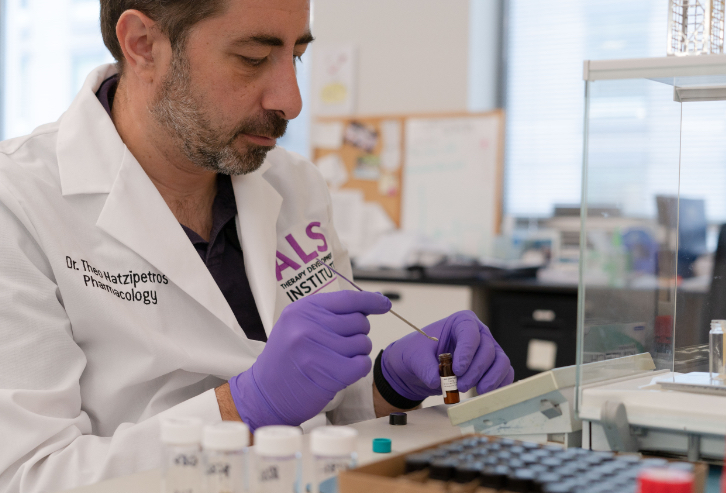
“We depend primarily on philanthropy and fundraising,” says Dr. Theo Hatzipetros, ALS TDI’s Director of Pharmacology, “and this makes our budget a lot smaller compared to many for-profits. But at the same time, it makes it more predictable.”
Our smaller budget relative to a similarly sized start-up in the biotech industry means that we must be more selective about the projects we pursue, but this consistency also affords some advantages.
“We have to make smarter choices when it comes to science and what experiments we actually perform,” says Dr. Hatzipetros. “Because we cannot do everything. However, we can plan for experiments to run for longer periods of time. You can plan research programs that might need three years to complete because the funding is consistent. In the case of a startup, investors might tire of you, and you might not exist in two years.”
In addition to giving us breathing room to explore the most promising experiments, the non-profit model allows ALS TDI to take a more comprehensive approach to the disease.
Often, in the traditional structure of drug development, the biological mechanisms behind how a disease affects the body are studied in an academic setting, which informs drug discovery at for-profit biotech’s through publications in peer-reviewed science journals. At ALS TDI, we are able to study both potential treatments and the mechanisms of the disease itself, through programs like the ALS Research Collaborative (ARC). ARC, the longest-running natural history study in ALS, partners with people with ALS all over the world to gather data and learn more about the disease. These data help inform our own science and are shared with other researchers working to end the disease around the world through the ARC Data Commons.
A Drug Discovery Engine for ALS
Most for-profit biotech companies are formed around a particular treatment or technology, which they may simultaneously develop for multiple different diseases. If one of their drugs receives approval after reaching clinical trials, they may then shift part of or all their focus to manufacturing and marketing.
A key part of our mission is to serve as the Drug Discovery Engine for ALS—feeding the clinical pipeline with ALS drugs until there are treatments for every person living with ALS. Once we have discovered and optimized a potential treatment, we then hand it off to a partner company to advance it to clinical trials. This allows us to continue working to discover new treatments, rather than dedicating our resources toward supporting a single drug as it moves through human trials.
Collaborating to end ALS
Beyond inventing treatments in our own lab, as a nonprofit, we are also able to dedicate resources to replicating studies and validating potential drugs produced by others. Our only goal is to find treatments for ALS, whether they’re our intellectual property or not.
“Our setup promotes collaboration with outside partners,” says Dr. Hatzipetros. “More Big Pharma companies or academic institutions are willing to talk to us, because they don’t see us as a threat or a competitor. And this provides us with access to more technology and knowledge than might be available to a startup or for-profit biotech.”
Accountability to the ALS Community
The fact that our research is made possible by donations means that we are directly responsible to our supporters in the ALS community, including the many people living with ALS.
“We have to be accountable to people living with ALS, not investors,” says Dr. Hatzipetros. “And this has an impact on the science too. We must be more cautious in the interpretation of our findings. We cannot play up our discoveries. We also don't over-promise, in fear of under-delivery. And this isn't just for people with ALS, but also for the philanthropists, for the donors, because our credibility is at stake.”
“Another difference is the culture within the company,” he continues. “We’re more mission-driven. We're less competitive amongst ourselves and more collaborative. The team spirit is very strong. People living with ALS visit the lab, and this inspires and motivates employees. It gives us a sense of urgency and responsibility.”
To learn more about ALS TDI’s research to end ALS, visit our ALS Research page here.
What to Do Next: