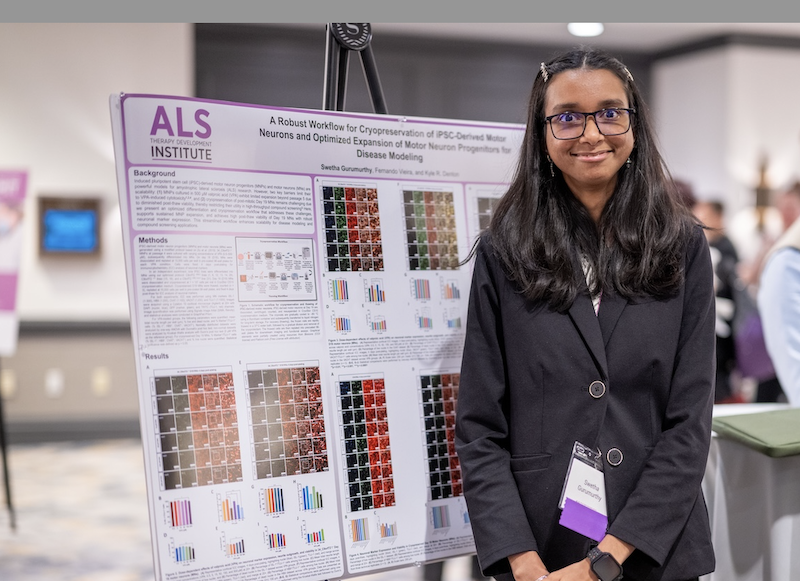
Microimaging, or microscopic photography, is an important part of the ALS Therapy Development Institute’s (ALS TDI) preclinical drug discovery research. This process involves the use of advanced microscopy and a process called immunostaining, which allows them to apply bright fluorescent dyes to individual structures within a cell. These images are crucial tools for ALS TDI’s cell biology team, allowing them to assess the condition of cellular models of ALS and observe if experimental treatments are having an effect.
Although their primary purpose is scientific, not aesthetic, these images can be visually striking. Inspired by the images she creates as part of her role, ALS TDI’s Associate Scientist II Swetha Gurumurthy, has submitted her work to several national and international scientific photography competitions. In 2025, she received her most prestigious recognition yet when she was named a runner-up in the UK’s Royal Society Publishing Photography Contest in the microimaging category.
Swetha joined us to discuss the scientific and aesthetic importance of her microimaging work and what it meant to her to receive this prestigious international award.
——
Q&A with Swetha Gurumurthy
ALS TDI: First off, can you introduce yourself and say a little bit about what you do at ALS TDI?
Swetha Gurumurthy:
Hi, I’m Swetha. I hold a bachelor’s degree in Biotechnology and a master’s degree in Human Physiology. I’ve been with ALS TDI for about three years, and I currently work as an Associate Scientist II on the Cell Biology team.
I work closely with Dr. Kyle Denton, Senior Director of Cell Biology, on projects focused on immunostaining and cellular modeling of ALS. Our research uses induced pluripotent stem cells (iPSCs), which we differentiate into motor neurons to study disease mechanisms. By comparing these ALS mutation lines with control lines derived from healthy cells, we aim to identify key ALS-related phenotypes.
To visualize and analyze these neurons, I use immunostaining techniques to examine specific disease markers. This approach allows us to closely compare the cellular characteristics of ALS models with healthy controls, helping us better understand the biological changes associated with the disease.
The Royal Society Publishing Photography Contest
ALS TDI: Can you talk about this competition you entered, the Royal Society Photo Contest?
Swetha Gurumurthy:
The Royal Society stands as one of the world's oldest and most prestigious scientific institutions, with a legacy spanning over 360 years of advancing scientific knowledge. Each year, the organization hosts the Royal Society Publishing Photography competition, attracting hundreds of submissions from researchers worldwide who seek to showcase the beauty hidden within their scientific work.
The 2025 competition drew over 500 entries from scientists across the globe, with judges selecting only one winner and one runner-up per category—making recognition exceptionally competitive. I was deeply honored to learn that my submission, “Neurite Nexus: The Blueprint of Motion,” was selected as the runner-up in the microimaging category.
This recognition carries particular significance because the Royal Society has championed scientific excellence since 1660, with past members including Isaac Newton, Charles Darwin, and Stephen Hawking. To have my work acknowledged by an institution that has shaped the course of modern science—and to join a lineage of researchers whose imaging has advanced both scientific understanding and public engagement—represents a milestone in my career.
Following the official announcement on the Royal Society’s website, the image was featured across multiple national and international media outlets, including PetaPixel, ZME Science, and Mashable India, among others. This visibility not only celebrates the intersection of science and art but also helps communicate the intricate beauty of neuroscience research to broader audiences beyond academia.
The Story Behind the Image
ALS TDI: The image you submitted is clearly very interesting. Can you tell us more about what we’re looking at here?
Swetha Gurumurthy:
The image I submitted was captured as I was learning the process of neuronal differentiation. Our work begins with reprogrammed induced pluripotent stem cells (iPSCs)—cells capable of becoming any cell type in the body. We guide these iPSCs through a three-week differentiation process to become motor neurons, the cells that control voluntary movement and are particularly vulnerable in ALS. These patient-derived neurons allow us to study disea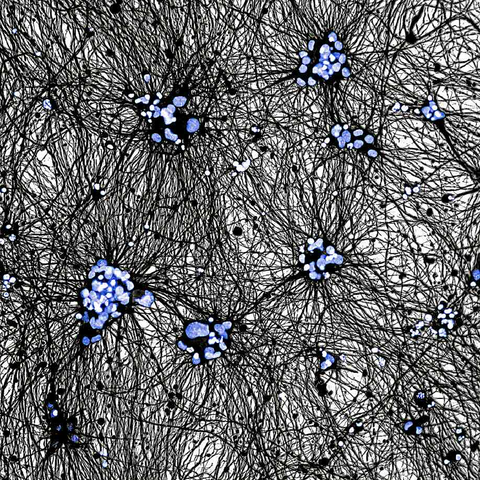 Image submitted by Swetha Gurummurthy for the Photography Contest
se-relevant phenotypes while preserving the donor's genetic background. We use immunostaining to confirm successful differentiation before proceeding with experiments.
What drew me to this image was its striking visual contrast: black neurites extending from neuronal cell bodies stand out against a white background, while blue nuclei mark each cell. The composition reveals the intricate network these cells form as they communicate with one another. The judges evaluate submissions on both visual appeal and scientific narrative, and this image captured both elements.
I was genuinely surprised when my image was selected as runner-up. The recognition became even more meaningful when the Royal Society chose it as the cover for the Journal of the Royal Society Interface this month—a high-impact interdisciplinary publication. Seeing my work featured on the cover of such a prestigious journal highlights both personal achievement and the elegant complexity of neuroscience research.
What Goes Into Capturing an Image Like This?
ALS TDI: What goes into capturing an image like this?
Swetha Gurumurthy:
The path to producing high-quality microscopy images like this is far more complex than simply placing cells under a lens. This meticulous process took over a year of optimization—work I presented at the 2025 International ALS/MND Symposium and the ALS TDI Summit. It involves multiple interconnected steps, each requiring precision and extensive troubleshooting.
- Neuronal differentiation:
The process begins with differentiating iPSC-derived motor neurons, which takes approximately three weeks under optimal conditions. However, success is never guaranteed—stem cells can spontaneously differentiate into unintended cell types, or cultures can become contaminated, forcing you to restart from scratch. - Automation protocol development:
To achieve consistency and reproducibility, I developed custom protocols using our Biomek automated liquid handler to perform the staining process. This automation was critical for handling the delicate neurites without causing damage, but programming and optimizing these protocols required roughly six months of iterative testing. - Immunostaining optimization:
The actual immunostaining is particularly challenging because neurites are extraordinarily fragile. Harsh liquid flow rates or improper volumes can cause neurite fragmentation, destroying weeks of work in seconds. I tested countless combinations of settings—adjusting speeds, volumes, and handling parameters—until finding conditions that preserved neuronal integrity. The immunostaining protocol itself spans two days. - I
- maging and post-processing:
Once cells are successfully stained, the imaging phase begins, followed by two additional days of post-processing to extract high-quality, publication-ready images. Only at this final stage can you assess whether everything worked.
What This Recognition Means
ALS TDI: After putting in all that work, what did it mean to you personally to receive this kind of recognition for your imaging work?
Swetha Gurumurthy:
Beyond the Royal Society competition, I entered several other imaging contests this year. Thermo Fisher Scientific's GIBCO competition selected my image to be featured on their 2025 annual calendar, as did BioLegend for their calendar. The Royal Microscopical Society—another prestigious UK-based organization founded in 1839—chose one of my images as a finalist in their photography competition. The image was subsequently featured in their MMC 2025 exhibition, which showcases outstanding microscopy work from around the world.
Hearing from these organizations was emotional. These competitions receive hundreds of entries from scientists worldwide, and the selection standards are exceptionally high. The judges—distinguished experts in microscopy and scientific imaging—evaluate not only visual impact but also the scientific story each image tells. Knowing that my work stood out among such competitive fields felt surreal.
What moved me most was the recognition this brings to ALS TDI on a global platform. We work relentlessly as scientists here, often behind the scenes, tackling one of the most challenging neurodegenerative diseases. Creating these images is far from easy—it represents months of optimization across multiple interconnected steps, where a single error can erase weeks of progress. Yet every image was produced entirely within our facility using our Cytation 10 microscope, from differentiation through final imaging.
These awards affirm that our work matters, that the rigor and dedication we bring to ALS research is visible to the broader scientific community. Seeing ALS TDI recognized on international stages validates not just my efforts, but the collective commitment of everyone at the institute working toward better treatments and, ultimately, a cure for ALS.
What to Do Next: