ALS drug discovery is the process of identifying, testing, and advancing potential treatments from early scientific concepts to clinical trials. ALS is a highly complex condition with many different causes, making it unlikely that a single therapy will be completely effective for everyone with the disease. To develop medicines for the many types of ALS, multiple therapeutic approaches are likely needed.
Drug discovery is a multi-stage process, encompassing everything from experiments to investigate the root causes of the disease to testing potential treatments in animals and, eventually, human volunteers. Through this process, researchers narrow down the possibilities from a nearly infinite number of potential therapeutic compounds to individual drug candidates for clinical testing.
The ALS Therapy Development Institute (ALS TDI) is one of the few labs with end-to-end capability across this process for ALS – bringing preclinical, translational, and clinical research programs together in a single, integrated system to move faster and reduce the gaps that often slow progress in ALS drug development.
What is the ALS Drug Discovery Process?
1. Basic Research
Basic research encompasses any studies conducted by academics, pharmaceutical companies, and others to understand the underlying biology of a disease and how that disease might be treated. This is often where scientists discover drug targets – the biological pathways they will then attempt to modify with drugs to treat a disease.
2. In-vitro Testing
Once researchers have a drug target of interest, they can begin testing drug-like compounds that they believe might affect it. These experiments are often conducted by testing hundreds or even thousands of compounds in cellular models of a disease.
The compounds that show promise in these tests are known as “hits.”
3. In-vivo Testing
Hits that show the most promise will be moved into testing in animal models of a disease – most commonly mice, but sometimes others such as fish or fruit flies. These tests take much longer than experiments in cellular models, but, because they occur in living animals rather than individual cells, they are usually more representative of how a drug might affect a human.
Drugs that show promise in these tests are called “leads.” As researchers learn more about which leads appear to work well, and which ones appear ineffective and/or harmful, they may chemically modify the compound in question to try to improve its performance. Through this stage of study scientists will also gather information on what doses are the safest and most effective and build a dosing strategy.
4. IND-Enabling Studies
Leads with the most promising preclinical data behind them may be advanced to a final round of safety and quality control testing called “investigational new drug (IND)-enabling studies.” Federal law in the US requires that any potential treatment submit satisfactory data from a battery of IND-enabling studies to the FDA before the drug’s sponsor can begin conducting human clinical trials. During these studies, drugs are often tested in larger animals that more closely mimic human biology.
Sponsors must also submit information about how the drug will be manufactured and outline their plans for the clinical trial they plan to conduct. FDA regulators will then review the results from these IND-enabling studies along with the sponsor’s trial plans. If they conclude that the collective data from the preclinical studies support advancement into a trial, then the clinical trial can move forward.
5. Advancing to Clinical Trials
Leads with strong preclinical data advance through Investigational New Drug (IND)-enabling studies – the primary goal of which is to demonstrate that a drug will be safe for use in humans with as much certainty as possible before asking volunteers in a clinical trial to take it. Human trials then proceed in as many as four phases:
- A phase I clinical trial determines whether a treatment is safe and tolerable in people. Phase I studies are typically small in scale, several months in length, and used to understand how a treatment interacts with the human body.
- A phase II clinical trial determines whether a treatment is safe, tolerable, and potentially effective in people with a particular condition. Phase II studies inform researchers about side effects, dosages, and may give initial indications about the efficacy of the treatment.
- A phase III clinical trial evaluates the potential efficacy of a treatment. Information is also gathered on long-term use and side effects. It is not uncommon for a phase III clinical trial in ALS to enroll upwards of 1000 participants and take several years to complete. The results from Phase III studies are used by the FDA to decide on the approval of a treatment.
- A phase IV clinical trial often takes place after the intervention has been approved by a regulatory agency, allowing further study of the long-term safety and efficacy of the treatment in a broader population.
Why is ALS Drug Discovery Challenging?
ALS presents unique obstacles at every stage of development:
- Biological complexity: ALS is heterogeneous, meaning that it can be variable in its onset, progression, and biology from person to person. Only about 15% of ALS cases are familial, with a known genetic cause. The remaining 85% are sporadic, with no known cause.
- Limited options for disease modeling: What works in preclinical models of a disease does not always translate to humans. This is a particular challenge in ALS, where currently available models don’t reflect the biological diversity of different forms of the disease.
- Symptom measurement: ALS has few reliable biomarkers associated with severity and progression, forcing researchers to rely primarily on subjective measures. More sensitive measures could help researchers see if treatments are having an effect with more precision.
- Rapid progression: While the average lifespan after symptom onset is three to five years, some people have lived for decades with the disease and others may pass away after only a matter of months. This pace limits the window for intervention.
All these factors contribute to the historical difficulty of developing treatments for ALS. However, organizations like ALS TDI are making progress in overcoming these obstacles.
Because of the heterogeneity of ALS, we know it will take many drugs to end it. That’s why ALS TDI is dedicated to doing the preclinical research needed to invent and advance many potential ALS drugs to human clinical trials – and not to stop until there are treatments for everyone with ALS.
The Role of ALS TDI: A Drug Discovery Engine for ALS
ALS isn’t one disease, and we will need multiple treatments to eventually end it. ALS TDI will continue to invent and discover drugs until everyone with ALS has effective treatments.
ALS TDI is the most comprehensive preclinical research institute dedicated solely to ALS. As a nonprofit biotech, ALS TDI only answers to the ALS community. This allows us to pursue the avenues of research we believe will have the greatest impact for people with ALS.
ALS TDI’s role is to serve as the Drug Discovery Engine for ALS – filling the clinical pipeline with candidates until there are treatments for every person with ALS:
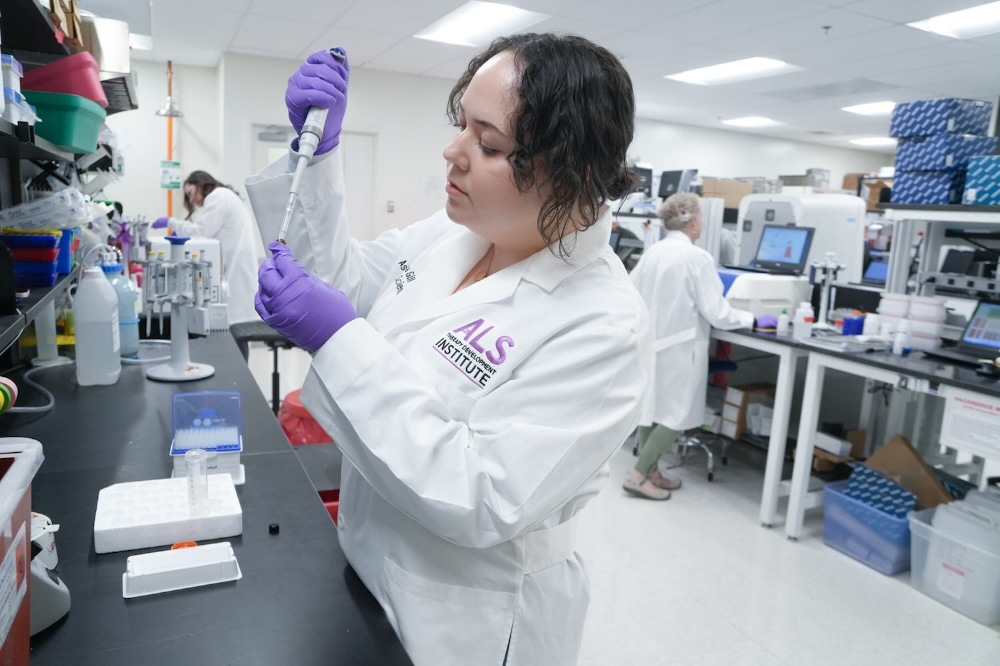
- Every day in our lab, ALS TDI scientists conduct basic research, drug discovery, and lead optimization efforts, all under one roof. This work has enabled multiple therapies for ALS to move forward into human clinical development.
- Once a potential treatment is discovered and optimized, ALS TDI hands it off to a clinical partner to advance it to human trials. This model allows us to continue working to discover new treatments, rather than dedicating all resources toward supporting a single drug as it moves through human trials.
- Through our ALS Research Collaborative (ARC) study, we are working to develop new biomarkers and patient stratification strategies that will help make clinical trials faster and more efficient.
How You Can Be Part of the Process
People living with ALS play a critical role in drug discovery. Two key ways to participate:
- Participate in an interventional trial: Volunteering for an interventional clinical trial allows people with ALS to participate in research while potentially accessing investigational treatments, adaptative devices, or other interventions.
- To aid in this decision-making process, ALS TDI has developed ALS Trial Navigator, an innovative platform that educates people with ALS about current clinical trials and provides personalized recommendations based on eligibility and preferences.
- Participate in observational research: Unlike interventional clinical trials, observational studies do not offer any form of intervention — their purpose is to gather data to help researchers better understand the disease. Observational studies present an opportunity for people with ALS to contribute data that can inform the discovery of new treatments.
- ALS TDI’s ALS Research Collaborative (ARC) Study is the longest-running natural history study in ALS. Through ARC, researchers at ALS TDI partner with people with ALS to gather data to learn more about this disease. People from around the world share their data on movement, lifestyle, medical history, genetics, biomarkers, voice recordings, and patient cell biology. These data are also shared with the global ALS researcher community through the ARC Data Commons.
The more data that are shared, the more researchers can learn about why ALS impacts people so differently – and how to effectively treat it.
Key Takeaways
- ALS drug discovery is a multi-step process from basic research to clinical trials
- ALS is not one disease – it is heterogeneous in its onset, progression, and biology, requiring multiple therapeutic approaches
- Challenges for developing and testing ALS treatments include the disease’s complex biology, rapid progression, and a lack of reliable biomarkers
- New tools – such as better models, new biomarkers, and a deeper understanding of the heterogeneity of ALS – could help improve success rates
- ALS TDI is the world’s largest drug discovery lab focused solely on ALS, with an integrated approach to preclinical research that has helped advance multiple drugs to clinical trials
Frequently Asked Questions
How long does ALS drug discovery take?
From early scientific concept to potential approval, the process typically takes a decade or more, spanning four phases of preclinical research – basic research, drug discovery, lead optimization, and IND-enabling studies – followed by three phases of clinical trials. Because of the length of this process, and the high rate of failure for clinical trials, it is essential that we continue to feed the ALS clinical pipeline with many new potential treatments.
Why do ALS treatments fail in clinical trials?
Across all diseases, less than 10% of drugs that enter clinical trials succeed and receive approval. In ALS, drugs have historically failed due to poor translation from models to humans, one-size-fits-all approaches that don’t account for disease heterogeneity, and tools that do not fully capture whether a treatment is meaningfully changing disease progression. Developing better disease models, biomarkers, and patient stratification approaches are ways ALS TDI is working to change this.
What is preclinical research in ALS?
Preclinical drug discovery is everything that happens in the process of inventing new drugs and treatments for a disease before trials in humans. This begins with research into the drivers of a disease progression and why they lead to certain symptoms, and what kinds of treatments might help slow or stop the disease. It also encompasses testing potential drugs for effectiveness and safety in cellular and animal models of the disease. The goal is, at the end of this process, to advance promising drugs into clinical trials.
How are new ALS treatments developed?
New ALS treatments are developed through a multi-stage process: identifying drug targets, designing or selecting a therapeutic approach, testing in cellular and animal models, and ultimately advancing to human clinical trials.
What role do patients play in ALS research?
People living with ALS play a critical role in drug discovery. Through the ARC Study, ALS TDI gathers vital data from people with ALS to better understand the disease and speed up treatment development. These data are used to identify new drug targets, test potential treatments in iPSC models developed from ARC participants’ samples, discover new biomarkers, and define ALS patient subsets. The more data that are shared, the more researchers can learn about why ALS impacts people so differently, and how to effectively treat it.