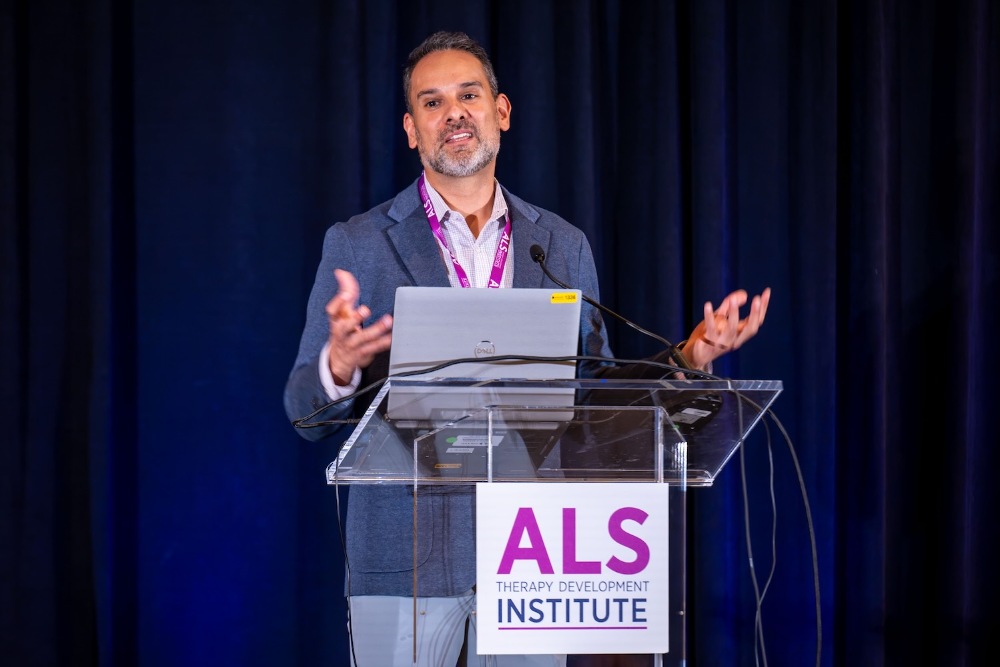
At the 2026 ALS TDI Summit, researchers came together to showcase how new discoveries, novel technology, and expanding capacity are helping to bring us closer to a future with treatments for every type of ALS. Hundreds of researchers and community members joined both in-person and virtually for the event.
The ALS TDI Summit began with an overview from ALS TDI CEO and Chief Scientific Officer Fernando Vieira, MD, followed by research updates from ALS TDI scientists, a panel discussion about the work to address both hereditary and sporadic forms of ALS, and presentations from collaborators across the ALS research community.
Explore some of the key takeaways from the presentations and panel discussion below:
FERNANDO VIEIRA, MD | CEO AND CHIEF SCIENTIFIC OFFICER, ALS TDI
Building What ALS Demands
Key Takeaways:
- ALS is not one uniform disease, since people can start with different symptoms and follow very different paths, and more than 30 genes have now been linked to it. This means treating ALS will likely require many different therapies, not a single one.
- Gene-targeted medicines now exist for two rare genetic forms of ALS (SOD1 and FUS), showing that understanding the underlying biology can lead to real treatments. It also means that each form of ALS may need its own drug discovery program.
- Dr. Vieira compared this moment to a fork in the road, noting that ALS cannot afford to pick just one path. ALS TDI and the wider field are building ways to travel many at once.
- Cell biology, animal pharmacology, clinical research, and a newly formalized data science team work together at ALS TDI, so that data from each can be combined to guide decisions across many programs.
- ALS TDI will move to a new 33,000-square-foot facility in early 2027 and double the size of its science team—creating research capacity so there is less need to choose between promising ideas. Dr. Vieira expects the impact to grow by more than the increase in headcount, and he said the added space and staff will let ALS TDI test ideas from outside collaborators much more quickly.
- Outside researchers can use the ARC Data Commons under a simple data use agreement or bring ideas to test in ALS TDI’s models, and the expansion should help ALS TDI answer those requests much more quickly.
KYLE DENTON, PHD | SENIOR DIRECTOR, CELL BIOLOGY, ALS TDI
Modeling TDP-43 Loss-of-Function in Human Motor Neurons: From Cryptic Splicing to Drug Discovery
Key Takeaways:
- ALS TDI creates induced Pluripotent Stem Cell (iPSC) models of motor neurons from donated skin and blood cells from ARC Study participants. These models allow researchers to compare ALS with healthy cells and test potential ALS treatments.
- TDP-43 normally helps remove stray pieces of genetic messages called cryptic exons, and when it stops working, these pieces build up and reduce the levels of important proteins such as STMN2 and UNC13A. TDP-43 pathology appears in about 97% of ALS cases, including those with no known genetic cause.
- To model this, the team created motor neurons with TDP-43 removed and added a reporter that makes the cells glow green when TDP-43 is not working. These neurons grew about 50% less than normal cells, and one cryptic exon rose roughly 80-fold.
- Cardiac glycosides, a drug class that includes digoxin, kept TDP-43 inside the nucleus in stressed cells. Digoxin is now in an ALS clinical trial at Massachusetts General Hospital.
- An RNA-binding small molecule drug improved neuron survival and growth even without TDP-43, and the team is now screening about 3,000 compounds for similar effects.
- The PRISM consortium, a collaboration between ALS TDI, Axol Bioscience, and LifeARC, is building stem cell models of sporadic ALS, and the cell lines may become available to outside researchers within the next year.
THEO HATZIPETROS, PHD | SENIOR DIRECTOR, PHARMACOLOGY, ALS TDI
Leveraging the SOD1 Mouse Model to Evaluate Diverse Therapeutic Mechanisms in ALS
Key Takeaways:
- ALS can involve multiple biological problems, affecting motor neurons, their support cells, and the connections between nerves and muscle. As a result, treating it will likely require more than one therapy.
- The SOD1 G93A mouse model reproduces nearly all of the disease mechanisms documented in people with ALS, which lets ALS TDI test several treatment strategies.
- ALS TDI researchers are constantly testing potential therapies in the SOD1 model. Recently tested therapies included:
- Clopidogrel, an approved blood-thinning drug, preserved the connections between nerves and muscle in SOD1 mice. However, it did not improve measures of muscle function or strength. A survival study is the next step.
- SN-011, which blocks an inflammation pathway called cGAS-STING. It was shown to delay disease onset and extend survival by about 10 days in male SOD1 mice. However, it did not help female mice. The team is investigating why and plans to repeat the study in a second mouse model.
- Mebendazole, an approved anti-parasitic drug, targets a protein called TNIK, linked to nerve fiber degeneration. It delayed disease onset and extended survival in both male and female SOD1 mice. The team plans to validate the result in SOD1 mice and a second model.
- Combining therapies may eventually offer more benefit than any single treatment, though testing combinations in animals is difficult because of drug interactions, large study sizes, and the risk of added toxicity.
ALAN PREMASIRI | DIRECTOR, CLINICAL RESEARCH OPERATIONS, ALS TDI
Expanding Capabilities of the ARC Platform
Key Takeaways:
- ALS TDI, Augie’s Quest to Cure ALS, and Answer ALS have launched the Champion Insights Study, enrolling veterans, first responders, and elite athletes—groups in which ALS has been reported more often.
- Champion Insights is built on the architecture of the ARC Study, the longest-running natural history study in ALS. Data from both studies will be shared through the ARC Data Commons.
- Participants will report their lifetime physical activity and give blood samples for metabolic and genetic analysis. The study plans to enroll 200 people over its first two years and 300 more in a second phase.
- ARC participants will soon be able to see their blood test results in the participant portal, including neurofilament light (NfL), a protein released into the blood when nerve cells are damaged.
- Different lab methods report different NfL values, so results from different labs are not directly comparable unless they are shown as ratios or percentages. ALS TDI has brought NfL testing in-house to lower cost, turnaround time, and sample volume.
- ALS TDI is actively collaborating with researchers in the areas of multiomics, digital health technology, and translational science on projects powered by data and samples from the ARC Study.
DANIELLE BOYCE, MPH, DPA | DIRECTOR, DATA SCIENCE AND BIOMEDICAL INFORMATICS, PRINCIPAL INVESTIGATOR, REAL WORLD EVIDENCE, ALS TDI
Faster with AI, Guided by People: Data Science on the ALS Clock
Key Takeaways:
- ALS TDI uses AI to help write data analysis code, and every output is checked by the research team. Participant data is not uploaded to public AI tools, and the team develops its code using artificial data to protect participant privacy.
- Registry Forge, a free open-source tool funded by the CDC, turns electronic health records into research-ready data. Analysis that once took 30 days can now be done in a matter of seconds.
- Combining health records with participant surveys gives a more complete picture of ALS. For example, clinic notes can show how a person’s progression looked before they joined the study.
- Organizing data in common, shared formats makes it easier for AI and other researchers to use it. ALS TDI maps its data to open standards so that datasets can be combined and compared without mistakes or wasted time.
- Recording more detail about each person’s disease may help uncover clues, especially in sporadic ALS or when the genetic cause is unknown. Dr. Boyce said the field has not gone far enough in this area, and that new AI tools can find details in clinical notes even when no one asked about them.
- People remain essential to the work. ALS TDI staff catch data errors, check voice recordings, and coordinate with participants, and Dr. Boyce said AI cannot replace participants’ data or the donor support that makes fast work possible.
PANEL DISCUSSION
Hereditary vs. Sporadic ALS: What Have We Learned and Where Are We Going?
Moderator: Yentli Soto Albrecht, PhD
Panelists: Fernando Vieira, MD, CEO/CSO, ALS TDI; Michael Robinson, MD; Steven Altschuler, PhD, Professor, Pharmaceutical Chemistry, University of California, San Francisco; Danielle Boyce, MPH, DPA, Director of Data Science, ALS TDI
Key Takeaways:
- Panelists were hopeful that personalized treatments will eventually reach people with sporadic ALS, though they were uncertain about timing. They noted that personalization depends on grouping people with similar disease biology, not only on genetics.
- Studying genetic forms of ALS provides tools that can be applied to sporadic ALS. One example is a UCSF approach that searches for sporadic cases whose cells resemble genetic forms such as SOD1 and FUS, which already have targeted therapies.
- Grouping very different patients in trials may hide real treatment effects. Dr. Altschuler compared this to cancer research, where progress followed once tumors were sorted by molecular subtype.
- No single measure is likely to capture ALS progression for everyone. Panelists called for several complementary measures and a clearer definition of what change is meaningful to patients, and Dr. Vieira said digital measures are more sensitive but still need to be linked to what matters to people living with ALS.
- Neurofilament light (NfL) is a promising blood marker, but panelists cautioned against using it too rigidly. Dr. Robinson warned that a fixed cutoff chosen too early could cause useful drugs to be dropped, since it is not yet known how much of a reduction signals clinical benefit.
- Brain and spinal cord tissue from people with ALS is hard to obtain. Researchers are instead using cells from skin and blood that are reprogrammed into stem cells and grown into motor neurons, and the panel discussed patient advocacy as a way to improve access to donated tissue.
- Only about 10% of people with ALS qualify for clinical trials, so panelists pointed to observational studies and well-run expanded access programs as ways to learn from everyone else. Dr. Robinson stressed that expanded access gives people experimental drugs of unproven benefit, not approved treatments.
DAVID SHECHTER, PHD | PROFESSOR OF BIOCHEMISTRY, ALBERT EINSTEIN COLLEGE OF MEDICINE
PRMTs in ALS: From RNA Regulation to Therapeutic Opportunity
Key Takeaways:
- Dr. Shechter proposes that ALS is partly a disease of problems occurring along the flow of information from DNA to RNA to protein, which may be especially hard on large, long-lived motor neurons.
- PRMTs are enzymes that attach small chemical tags to arginine, one of the building blocks of proteins, changing how those proteins behave. More than half of the proteins they modify work with RNA, and nearly every ALS-linked protein, including FUS and TDP-43, is among them.
- Blocking different PRMTs had different effects on RNA processing in lab cells (not ALS cells). Blocking type 1 PRMTs slowed splicing, while blocking PRMT5 led to more splicing errors.
- A key open question is whether blocking type 1 PRMTs could reduce the cryptic exon errors that occur when TDP-43 stops working. Dr. Shechter said he does not yet have an answer, but early data from other labs hint that blocking PRMT5 increases some of these errors and blocking type 1 does not.
- In C9orf72 ALS, the toxic arginine-rich protein fragments appear to be methylated, and a type 1 PRMT-blocking drug reduced their toxicity in lab-grown neuronal cells. The fragments also seem to stick to RNA-related machinery inside cells, and methylation changes what they bind to, though it is still unclear whether methylation helps or harms.
- Existing PRMT-blocking drugs are not specific to individual PRMT enzymes, so Dr. Shechter’s lab and others are also using genetic tools, such as CRISPR-based gene silencing, to study each one.
MARCIN STRĄCZKIEWICZ, PHD | RESEARCH CONSULTANT FOR DIGITAL HEALTH TECHNOLOGIES
Measuring Change in Everyday Life with ALS
Key Takeaways:
- Wearable motion sensors can track ALS symptoms in everyday life, and the ARC study has collected these data since 2015 from sensors worn on both wrists and ankles. Dr. Strączkiewicz’s team compares the results with the ALS Functional Rating Scale (ALSFRS-R), the standard questionnaire used in trials.
- A new method tracks how the arm moves in space, such as lifting and rotating, providing the specific detail that broad questions about tasks like cutting food cannot. The resulting measures were linked to arm andleg function as well.
- People whose symptoms began in a non-dominant limb tended to rely more on their dominant limb, and vice versa, and the sensors picked up this pattern in everyday movement.
- Short at-home arm-swing exercises showed that movement intensity was the most reliable measure. The number of swings did not change much overall, and some participants improved over time, so the team is looking at whether practice effects play a role.
- Step counts recorded by the sensors were checked for accuracy and helped distinguish participants from one another. Other walking measures, such as stride and cadence, differentiate people who reported decline from those who did not. These results suggest no single measure may capture changes in leg function across every stage of ALS.
- Digital measures show promise for clinical trials, but more research is needed. Dr. Strączkiewicz said some digital measures have performed better than the ALSFRS-R in studies of about 12 months, but they are not yet ready for shorter trials. He noted that factors such as sensor placement and disease variability still need to be accounted for.
SMITH HEAVNER, PHD, RN, FCCM | SENIOR SCIENTIFIC DIRECTOR, DATA COLLABORATION CENTER, CRITICAL PATH INSTITUTE
Fit for What Purpose? Evaluating Digital Measures for Regulatory Use in ALS
Key Takeaways:
- Dr. Heavner works with the Critical Path Institute (CPATH), a public-private partnership with the FDA that helps prepare drug development tools for regulatory review. When developing new disease measures, he emphasized starting with the decision regulators will need to make, then deciding what to measure and which technology to use to best answer that question, rather than letting the technology lead.
- A digital measure needs to be “fit for purpose,” meaning it is clear what is being measured, in whom, and why. For example, a measure tested in one group of people may not support a claim about people at a different stage of their disease.
- A “context of use” statement spells out exactly what a measure will be used to decide, which determines how much evidence is needed.
- Building the case for a digital measure takes a body of evidence, not a single study. Formal FDA qualification is not the only path, since a letter of support from the FDA can also encourage wider use.
- Patients and caregivers should be involved from the start, because what a measure means to people living with ALS needs to be part of the case presented to regulators.
- Dr. Heavner expects the ARC study’s digital measures data to help build the regulatory framework for these tools, with lessons that could extend to other neurological conditions.
The ALS TDI Summit ended with the 2026 ALS TDI Leadership Awards, hosted by ALS TDI’s Senior Vice President of Development Carol Hamilton. The 2026 Leadership Award recipients included Caroline Tredway, Katie Rixman, PJ Murphy, The ALS 100 (Alex Litt, Cory Sullivan, and Zach Zangl), Dr. Yentli Soto Albrecht, Gwen Petersen, Doug & Lisa Downing, Logan Brunner, and Skyler Rodriguez. You can learn more about this year’s award winners here.
WHAT TO DO NEXT: