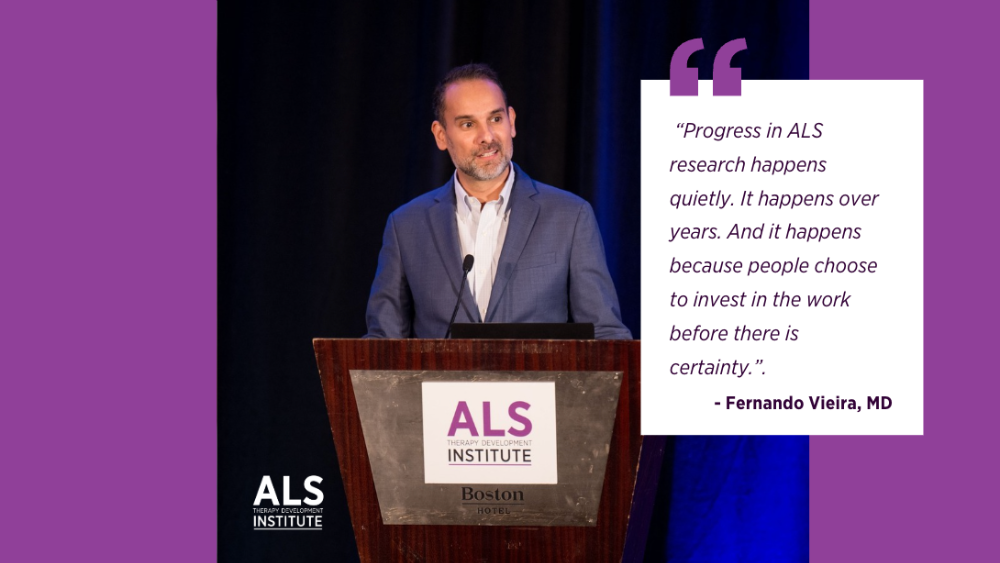
A letter from ALS TDI's CEO and Chief Scientific Officer, Fernando Vieira, MD
Dear ALS Community,
As we enter a new year, I want to pause for a moment—not to celebrate, but to take stock, and to survey the terrain ahead.
Last month, I wrote to you about AP-101 and the long arc of work that helped move it from preclinical science toward a Phase 3 clinical trial. That story matters not because the outcome is assured—it isn’t—but because it illustrates something essential about how progress in ALS research actually happens.
It happens quietly.
It happens over time.
And it happens because people choose to invest in the work before there is certainty.
That principle will continue to guide us in the year ahead.
In 2026, ALS TDI will be focused on doing three things exceptionally well.
First: we are expanding our team.
Not for growth’s sake, but because the science now demands it. Over the past year, our programs have matured—from early discovery into more translational, IND-enabling work. That transition requires additional expertise in pharmacology, biomarkers, in-vivo biology, data science, and therapeutic delivery. We are actively building a team capable of carrying ideas from first experiment to first patient—and of doing so rigorously, reproducibly, and without shortcuts.
Second: we are accelerating programs already in motion.
This includes continued advancement of TPII-1831 for rare, genetically defined forms of ALS, as well as rapid development of our precision mRNA delivery platform for the central nervous system. In parallel, we are continuing to expand the ARC Study—our longitudinal, patient-driven effort to understand ALS through deep clinical, molecular, and biomarker data collected over time.
We are also launching a new initiative, Champion Insights, designed to better understand ALS in populations at higher risk for developing the disease. By studying these groups carefully and respectfully, we aim to uncover biological signals and risk factors that may otherwise remain invisible—insights that could inform prevention, earlier detection, and more precise therapeutic strategies.
These efforts are complementary: some focused on near-term therapeutic hypotheses, others on building the knowledge base that future treatments will depend on. All are necessary. None are guaranteed. But together, they form a pipeline designed to learn quickly and fail honestly—or succeed decisively.
Third: we are committing to speed without sacrificing depth.
ALS is not a disease that allows for superficial answers. Every experiment we run is informed by patient-derived data, longitudinal studies, and hard-won lessons from programs that did not work. The goal is not just to move faster—but to move smarter, so that when something advances, it does so with the strongest possible foundation.
I want to be clear about something.
I cannot promise you which program will reach a clinical trial.
I cannot promise you when a breakthrough will come.
And I will never promise outcomes that science has not yet earned.
What I can promise is this: ALS TDI will continue to pursue work that is worth trying—especially when it is difficult, and especially when outcomes are uncertain.
That has always been our model.
It remains our conviction.
And it is only possible because of you.
As we begin this new year, your support allows us to hire the right people, run essential experiments, and give promising ideas the time and rigor they require. If you are able to make a gift, you are directly investing in the science that may one day change the course of this disease.
Thank you for your trust, for your patience, and for your impatience.
Fernando Vieira, M.D.
CEO & Chief Scientific Officer
ALS Therapy Development Institute