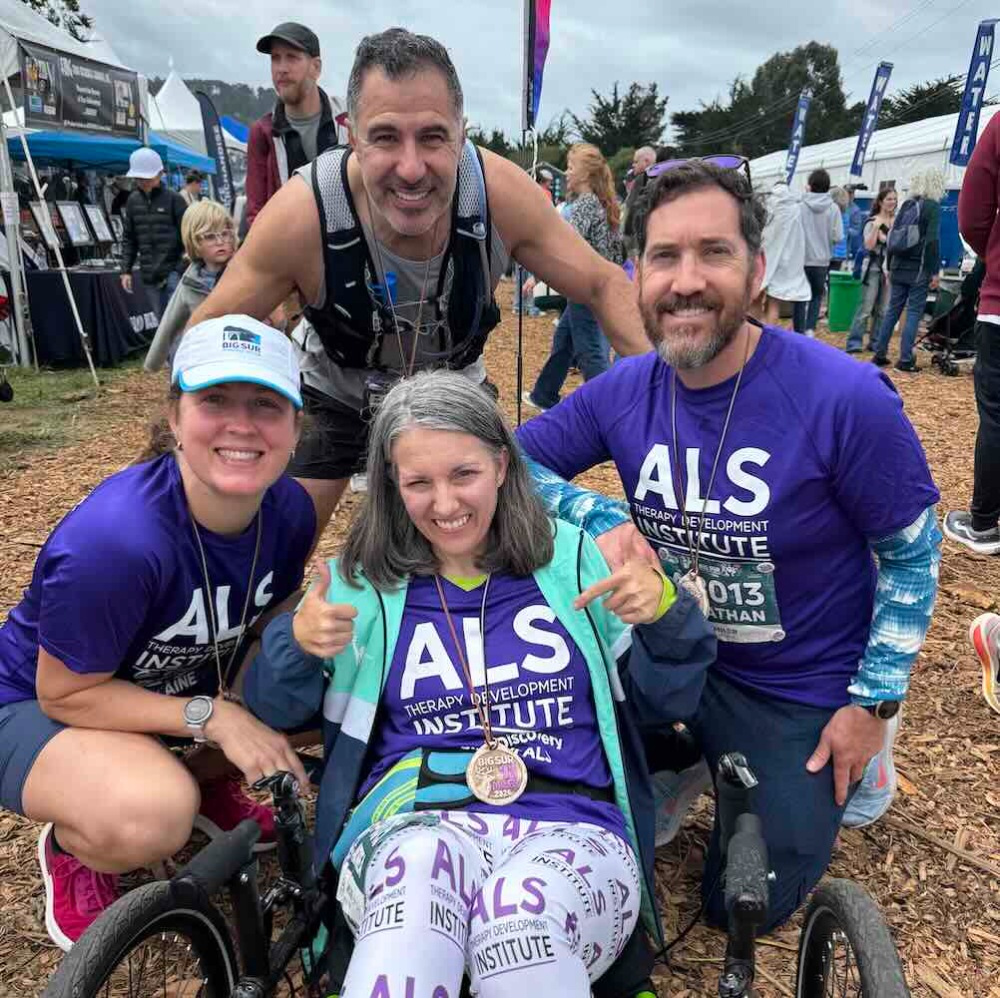
Andrea Lytle Peet has participated in a lot of marathons in a variety of places. That list includes one in every US state—a goal she set after being diagnosed with ALS in 2014 at the age of 33. However, there’s one race that she completed earlier this year that she says stands out among them all.
“I’ve done races all over,” she says. “But the Big Sur International Marathon was the most beautiful course I’ve done. It was stunning.”
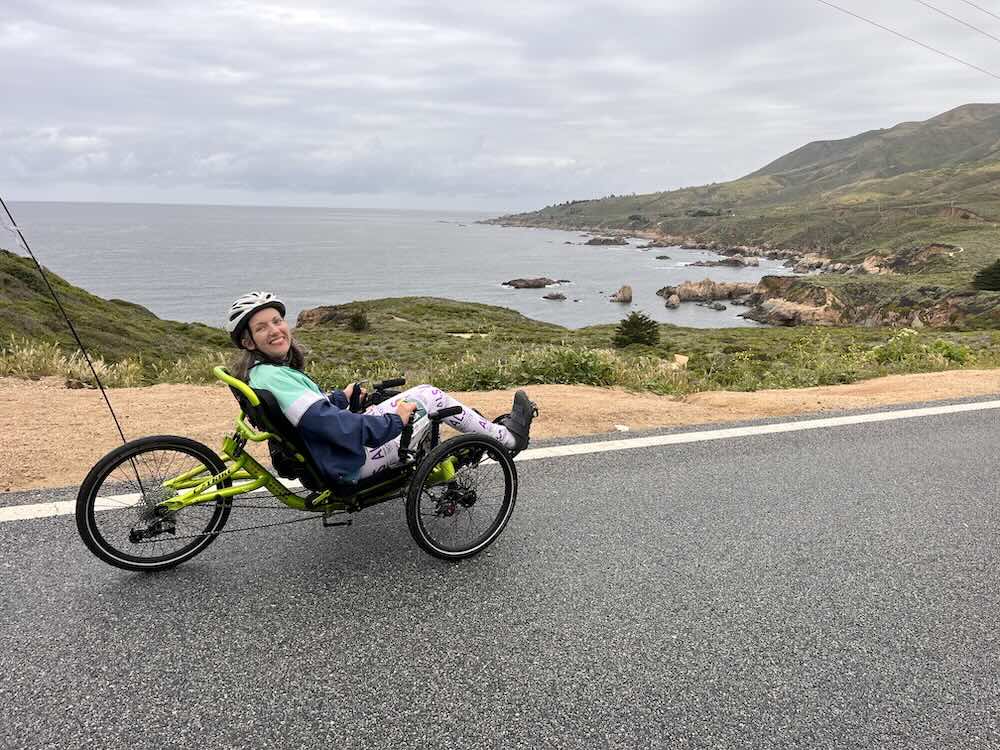
Looking at the Big Sur International Marathon’s course, it’s not hard to see why Andrea found it so impressive. The route stretches along California Highway One from Big Sur to Carmel, with the Santa Lucia Mountains on one side and the Pacific Ocean on the other. The road is closed for the race, creating a rare opportunity for runners to access this National Scenic Byway — one of the most iconic and busiest driving destinations in the country.
Racing for ALS Research
Andrea took part in the race in April 2026, along with her friends and frequent race partners Jillaine and Jon Baker. The three have known each other for more than a decade, since Jillaine, who lost her mother to ALS, heard about Andrea’s effort to compete in a final triathlon soon after her diagnosis. Inspired by her story, Jillaine began running to raise money and awareness for Andrea’s Team Drea organization and was soon running in races with Andrea herself.
“When I first heard about Andrea’s story, she had posted a challenge on her blog: ‘Do something hard, and donate $250 to support ALS research,’ Jillaine says. “My sister and I decided to try to PR a half marathon. When I connected with Andrea, she encouraged us to come to DC, where she was living, to race, and the rest is history. Now I sit on the board of Team Drea, and I run in whatever races she invites me to.”
This year, Andrea encouraged Jillaine and her husband Jon to join her at Big Sur as part of the ALS Therapy Development Institute (ALS TDI) Marathon Program. Through the Marathon Program, ALS TDI offers runners the opportunity to enter several races across the country and the world while raising funds to support ALS research. Team ALS TDI participants also receive support including training help, pre-race online meetups, and a group dinner the night before the race.
“I thought it was so great having dinner with everyone the night before,” says Andrea. “We got to know each other and talked about the race and our connections to ALS. While we were out running, I’d see people on the course, and it was like you were running with friends. We were all doing this together for a meaningful cause.”
“Having met the people online and then seeing them in person, I knew their family members or friends with ALS’ names,” adds Jilliane. “Those names stayed in my head as I was running, which was really meaningful for me.”
Breaking a Barrier for Accessibility
On race day, Jon and Andrea took on the event’s shorter 11-mile course. Andrea participated using her recumbent tricycle, breaking an important barrier as the first person allowed to enter the Big Sur International Marathon on wheels. She says that gaining entry to the event and coordinating the use of a mobility aid in a remote setting required a lot of hard work between herself, the race organizers, and the support team at ALS TDI.
“I was honored to be the first person on wheels that they allowed on the course,” she says. “And I’m thankful to [ALS TDI Development Director] Glynis Murray and the ALS TDI team for making it happen. There are a lot of logistics involved with this race, so I understand why they haven’t had a wheeler before, but kudos to the Big Sur International Marathon for being inclusive and starting to open it up.”
Jon, a much more casual runner than Jillaine and Andrea who was also nursing a soccer injury at the time, says that the hilly 11-mile course was challenging for him, but the setting and atmosphere of the race motivated him to keep pushing.
“The beauty and the vibe really helped,” he says. “There were people on the 11-mile course running for PRs, but there were also a lot of people who were stopping to look at the views and take pictures. And of course, being with the first person on wheels to do it was a big deal. A lot of people had heard Andrea’s story and were cheering her on, and so I felt cheered on as well.”
A Beautiful and Difficult Challenge
While Jon and Andrea were running the 11-mile, Jillaine was tackling the full 26.2-mile marathon. She says that full course was one of the most challenging of the seven marathons she’s completed.
“This marathon is not for the faint of heart,” she says. “The Hills are constant—you’re either going up or down a small hill or a big hill the whole time. I was shocked by how different it felt on my legs even from something like the Prince of Wales Island Alaska Marathon, where there were really big hills, but also flat stretches in between where you could recover.”
However, like Jon and Andrea, Jillaine says that the beauty of the setting and the encouragement of the runners around her made the race a rewarding experience despite the difficulty.
“I write my mom’s name on my back at every race,” she says. “At one of the steepest parts of the biggest hill, a guy came up behind me and just said, ‘Your mom would be so proud of you. Keep it up.’ I also had a woman stop me and say, ‘My grandma had ALS, thank you so much for running.’ Having people see you and what you’re doing and cheering you on like that—it just gave me a new amount of energy.”
The Most Beautiful Race for the Most Beautiful Cause
Looking back on their experience, Jon, Jillaine, and Andrea agree that what stands out the most about the Big Sur International Marathon is its setting. The remote beauty of the race’s location where the mountains meet the ocean comes with logistical and physical challenges. But, for them, the inspiration provided by its epic views and unique atmosphere—as well as the cause they were running for—made for an experience they won’t soon forget.
“It’s the most beautiful race,” says Andrea, “For the most beautiful cause.”
To learn more about the ALS TDI Marathon Program, click here.
What to Do Next