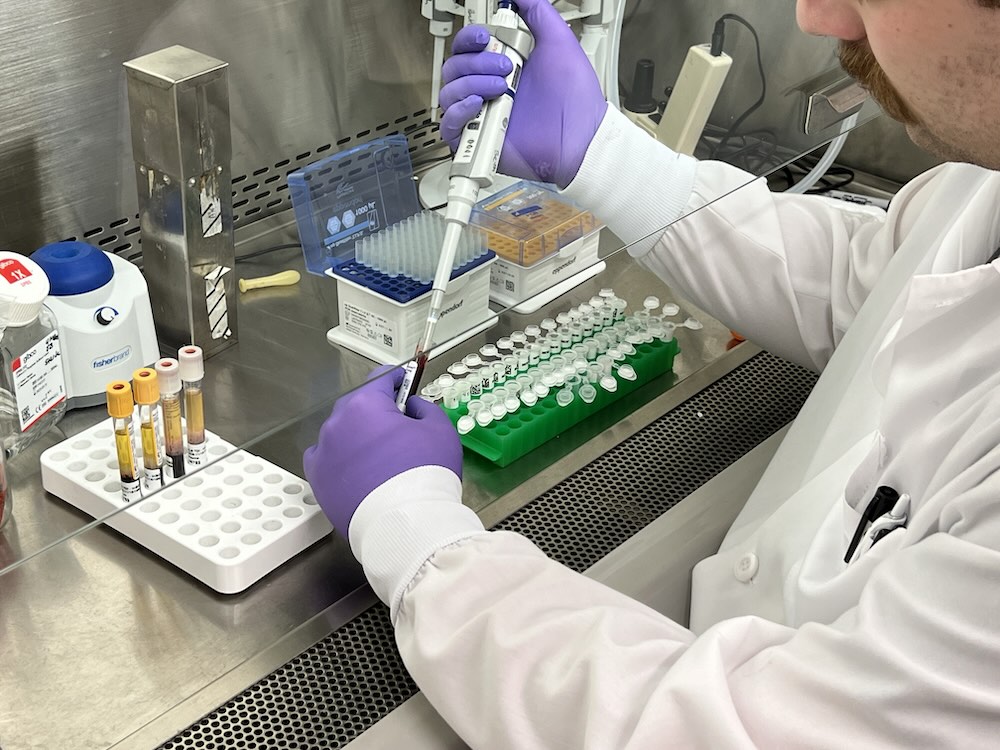
The ALS Therapy Development Institute (ALS TDI) is the world’s most comprehensive drug discovery lab focused solely on ALS. Led by drug development experts and people affected by ALS, our Watertown, Massachusetts–based lab is supported by a global community united around one goal: delivering effective treatments for people living with this disease.
ALS TDI was built to do something few organizations can – invent, test, and advance ALS therapies under one roof. By bringing preclinical, translational, and clinical research together in a single, integrated lab, we are able to move faster, learn more efficiently, and reduce the gaps that often slow progress in ALS drug development.
But ALS research faces unique challenges. The disease is biologically complex, treatments often fail late in development, and current clinical trials don’t always capture whether a therapy is truly helping. ALS TDI’s research strategy is designed to address these challenges directly through three critical pathways.
1. Inventing and Advancing New Kinds of Medicines
ALS is not a single disease, and it is unlikely that a single therapy will work for everyone. To develop medicines for the many types of ALS, we’re evolving our drug discovery strategies and techniques. Our scientists are building advanced models and scalable platforms that allow us to rigorously test many therapies in parallel – so we can identify the strongest ideas and move them forward faster.
Our approach includes:
- Inventing and standardizing new disease models to improve drug screening.
- Expanding beyond traditional ALS models to better represent the biological diversity of both familial and sporadic ALS.
- Pioneering new drugs and classes of therapeutics designed to address diverse ALS pathologies.
- Optimizing drug delivery approaches to ensure that therapies reach their intended targets, like the brain and spinal cord.
Examples of this work:
- Creating scalable iPSC-derived motor neuron models from people with ALS to support high-throughput screening.
- Advancing novel therapeutic programs such as TDI-1831and PRMT inhibitors.
- Exploring new drug delivery technologies, including mRNA-based therapies to penetrate the blood-brain barrier
Together, this work allows ALS TDI to evaluate many ideas at once—so progress does not depend on a single drug, target, or hypothesis.
2. Understanding the Full Spectrum of ALS
One significant barrier to effective ALS treatments is incomplete understanding of how the disease differs from person to person. Genetics, biology, and patterns of progression all influence how ALS develops and responds to therapy.
At ALS TDI, we study the nuances of ALS by pairing real-world data shared by people in our ARC Study with focused, hypothesis-driven experiments at the lab bench. By deeply understanding the many forms of the disease, we can pave the way for new targeted treatments.
Our approach includes:
- Leveraging data from participants in our ARC Study to gain comprehensive insights into ALS.
- Studying genomics, transcriptomics, proteomics, and metabolomics to understand the underlying biology of different types of ALS.
- Integrating findings from internal experiments with data from external research efforts.
This work helps us:
- Identify biologically distinct subtypes of ALS
- Understand why certain therapies may help some people but not others
- Design treatments that are better matched to the people most likely to benefit
This level of biological precision is essential to developing therapies that are more likely to succeed—and more efficient to test—in clinical trials.
3. Measuring Whether Treatments Truly Work
Many therapies that show early promise still fail in clinical trials. To address this, we work to identify specific patient populations and develop medicines tailored to their needs—but our work doesn’t stop there.
Even an effective drug can fail if its impact isn’t accurately measured, and current tools, such as the ALSFRS, do not fully capture whether a treatment is meaningfully changing disease progression. To close this gap, we are developing more objective, sensitive, and patient-relevant ways to measure treatment impact—so effective therapies can be identified earlier, with greater confidence, and fewer promising ideas are stalled.
Our approach includes:
- Developing and validating digital biomarkers that capture real-world function, such as movement and speech.
- Advancing blood-based biomarkers that reflect disease activity and progression.
- Leading collaborative efforts to improve how ALS clinical trials are designed and measured.
Examples include:
- Leading a large-scale study of neurofilament light chain (NfL) to evaluate its reliability as a biomarker of disease activity and treatment response.
- Partnering with regulatory science organizations to define best practices for incorporating wearable accelerometers as reliable measures of ALS symptoms in clinical trials.
- Conducting a funded collaboration with LifeArc to discover and validate new blood-based biomarkers of ALS.
This work helps ensure that clinical trials are better equipped to answer the most important question: Is this treatment truly helping people with ALS?
How You Can Support Our Research to End ALS
Ending ALS will require sustained effort, careful science, and the ability to test many ideas efficiently and responsibly. ALS TDI’s integrated approach – inventing new therapies, understanding the disease more deeply, and improving how treatments are evaluated – is designed to meet that challenge.
As one of the world’s only nonprofit biotech organizations dedicated entirely to ALS, our work is made possible by the ALS community. This support allows us to focus on the research we believe has the greatest potential to deliver meaningful progress for people living with ALS.
To learn more about how you can support ALS TDI’s research to end ALS, click here.
What to Do Next: