“Once you unlock delivery to a new cell type of interest, it becomes what we call a plug-and-play platform.”
— Dr. Michael Mitchell
Messenger RNA (mRNA) is a biological molecule that copies the genetic instructions encoded in our DNA and carries them to the parts of the cell that produce proteins. This process is a fundamental feature of life, allowing our cells to produce the many proteins our bodies need to function.
In a Nobel Prize-winning scientific breakthrough, mRNA-based vaccines were utilized to help stem the tide of the COVID-19 pandemic. These vaccines use specially designed strands of mRNA to help our immune system produce antibodies to fight the viral infection.
mRNA lipid nanoparticle (LNP) therapies for ALS are experimental treatments that use messenger RNA packaged in lipid nanoparticles to deliver therapeutic proteins to motor neurons.
mRNA’s Potential in ALS
mRNA-based treatments also have significant therapeutic potential beyond vaccines. In ALS, mRNA treatments could help address a variety of targets that contribute to the disease.
A key challenge, however, is delivering mRNA across the blood-brain barrier (BBB) and into neurons.
One potential solution is a drug-delivery technology called lipid nanoparticles (LNPs). LNPs are nano-scale fatty droplets that form when lipids are mixed with water. Scientists can place strands of mRNA or other therapeutic molecules inside LNPs, which are then injected into the bloodstream and taken up by cells. Once absorbed, the LNP dissolves, allowing the mRNA to begin producing the intended protein.
This technology was a crucial component of the mRNA COVID vaccines, but the LNPs used for those vaccines cannot cross the blood-brain barrier.
To develop LNPs capable of crossing the BBB and create a new class of mRNA-based ALS therapeutics, the ALS Therapy Development Institute (ALS TDI) is collaborating with Dr. Michael Mitchell of the University of Pennsylvania.
Dr. Mitchell is an expert in developing new drug-delivery methods using LNP technology. While ALS TDI’s team is working to create mRNA molecules that could treat the disease, Dr. Mitchell and his team are designing and testing LNPs that can deliver these treatments to neurons in the brain.
Interview with Dr. Michael Mitchell
Why are mRNA treatments promising for ALS?
ALS TDI: Why are mRNA treatments a promising candidate for treating ALS, and how can LNPs help make that possible?
Dr. Michael Mitchell:
So, we come at this from a drug delivery point of view, and ALS TDI are the ALS experts. What we learned when we first started talking to Dr. Fernando Vieira is that the ALS field has identified many different types of proteins that could drive the disease if they are either missing in the brain or present in a mutated form.
That’s important because we can potentially leverage protein replacement therapy to get neurons in the brain to express a protein that is missing, or a healthy protein instead of a mutant form.
The challenge with that is — how do you get those proteins into the brain? That's where we come in, because it becomes a delivery challenge. One of the most notorious barriers to therapeutic delivery in our body is the blood-brain barrier (BBB). So, some of the other treatments that ALS TDI is working on, like small molecules, may be able to cross the BBB. But, because the blood-brain barrier has very tight junctions between the endothelial cells that comprise that vascular barrier, protein delivery across the BBB is extremely challenging and inefficient.
What we’re asking is whether we can use these very tiny lipid nanoparticles to cross the BBB, get into neurons, deliver the mRNA, and then secrete therapeutic proteins. Or it could be absorbed by the BBB itself and then secrete the protein of interest.
There are a lot of people in neurological disorders using viruses to similarly deliver gene therapies across the BBB. But viral gene therapies have challenges because they trigger an immune response. Redosing viral therapies remains a challenge. You may be able to re-dose it once, but re-dosing repeatedly is not feasible. You don’t have that challenge with LNPs.
How did this collaboration with ALS TDI begin?
It started when we were in Seattle for a conference two years ago. At the time, Emily Han, a new PhD student in my lab, was very interested in brain delivery. To be honest, at the time, I thought it was a challenge that was too difficult to achieve. But Emily was really committed, and she came up with a strategy that demonstrated some LNPs do, in fact, transfect cells in the brain.
So, we became excited. We presented the work at a conference, and I posted about our presentation on LinkedIn. Fernando saw it and reached out. After meeting over Zoom, we quickly developed a one-page white paper and started collaborating.
ALS TDI had several proteins they were interested in for protein replacement therapy in the brain.
We started by looking in a model BBB system with neuronal cells to see if we could evaluate LNP transport in a dish. We looked to identify LNPs that are efficient at crossing through this blood-vessel-like barrier and then getting into neurons. That’s been the major work on our end, using our models to evaluate delivery across the BBB into neurons.
At the same time, ALS TDI is developing specific mRNA constructs to target TDP43-related biology and C9orf72 related biology. We're evaluating those to see if they alter the neuronal phenotype as expected. We meet once a month to go over updates as a team.
Ultimately, these projects will converge. Once we develop the LNP that works very well for crossing the blood-brain barrier, and once we have the optimal mRNA constructs we’re working on with ALS TDI, we’ll put them together and evaluate them as therapeutics.
What stage of development are these treatments at?
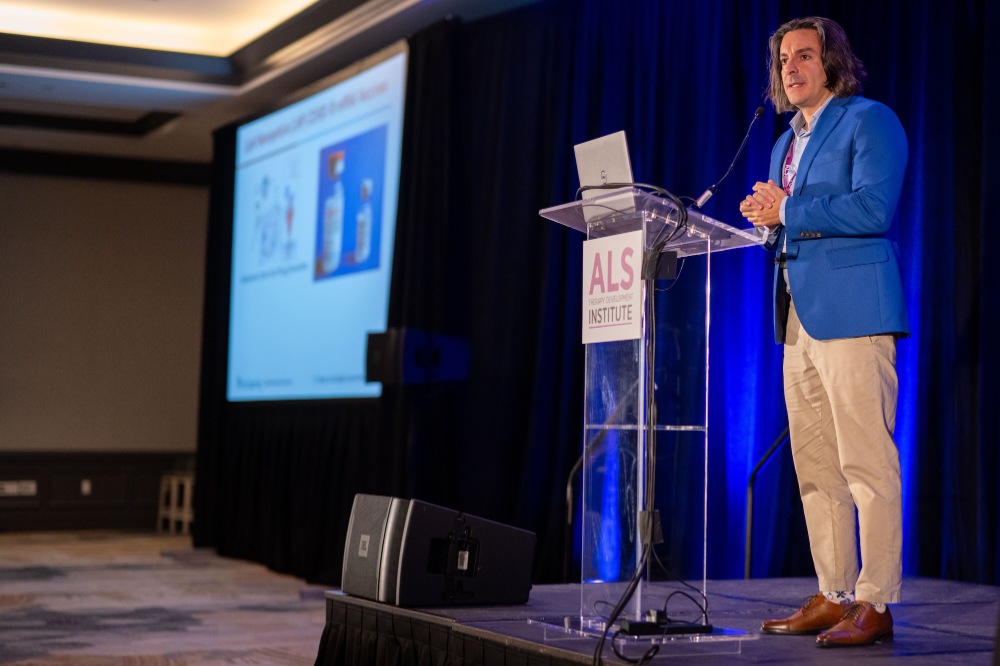
We were just recently talking about this at the ALS TDI Summit. There were a lot of patients there, and that was incredibly moving for me. I said to myself, “We need to do more for these patients, and they need new therapies as soon as possible.”
It's very hard at this stage to put an exact number to it in terms of years. Once we develop the right LNP and the right mRNA, the ALS TDI team needs to ask, “What is the best model to evaluate an mRNA-LNP protein replacement therapy?” Because this will be the first time an mRNA-LNP therapeutic has been evaluated for ALS, we want to make sure we have the right mouse model. That is going to take some time.
But, at the same time, we also have a great precedent for mRNA LNPs through the COVID-19 vaccines. They've been approved. They've been safe and effective. The FDA is familiar with LNP technology now. If we demonstrate efficacy in a mouse model and then pair that with safety in a non-human primate (NHP) study, the path to a clinical trial could follow shortly after that.
Could this technology be used for other ALS treatments?
Absolutely. That's why I love what I do — once you unlock delivery to a new cell type of interest, it becomes what we call a “plug-and-play platform.” If you're able to create an LNP that can cross the BBB and reach neurons, you could use it for different types of ALS or even different neurodegenerative diseases.
It's also plug and play in that we could have a C9orf72 mRNA that we're delivering initially, but mRNAs are generally relatively similar. So, if the research community comes up with additional protein targets that they want to deliver and secrete in the brain, we could swap out those mRNAs very easily. It doesn't even need to be mRNA to secrete a protein.
We can deliver siRNA, which will silence proteins. If there's a mutated protein we want to silence in ALS, we could substitute mRNA for siRNA. Or, if we want to permanently stop its expression using CRISPR Cas9 gene editing, we could deliver mRNA and guide RNA together to edit out deadly mutations. Once you get to that cell target with this new LNP technology, it opens many possibilities.
Once you solve the challenge of delivering therapies to neurons, many new therapeutic possibilities become possible.
Learn More
To learn more about potential mRNA-LNP treatments for ALS, watch Dr. Michael Mitchell’s presentation at the 2026 ALS TDI Summit here: https://youtu.be/KVvLzq_TmdY?si=NaHHcRoK3NIDIG8z
What to Do Next
Watch: Dr. Michael Mitchell’s presentation at the 2026 ALS TDI Summit
Support: Donate to support ALS research
Stay Informed: Subscribe to our newsletter for more stories like this